
SHARE THIS:
Search for StaticAir to Meet Industry Partners at Intertraffic Amsterdam 2026 in the web..

![【Air Canada®】Customer Service [Complete Guide] to Live Chat, Email & Calls Support Step by Step Guide](https://i.vimeocdn.com/video/2132883758-76836540f487dbf4d2735c2e46cfeabdd816a995b6d3683a4c719ec89793ce12-d?f=webp®ion=us "【Air Canada®】Customer Service [Complete Guide] to Live Chat, Email & Calls Support Step by Step Guide")





StaticAir to Meet Industry Partners at Intertraffic Amsterdam 2026
Cities across Europe are under increasing pressure to reduce traffic-related air pollution. One of the places where these challenges — and the solutions to address them — will be discussed is Intertraffic Amsterdam 2026, taking place from 10–13 March 2026 at RAI Amsterdam.
Intertraffic is widely recognised as one of the leading global events for professionals working in traffic infrastructure, road safety, smart mobility, tunnel engineering, traffic management, and environmental technologies. Every two years it brings together city authorities, infrastructure operators, engineering firms, and technology providers to discuss how transport systems can evolve to meet modern mobility and environmental challenges.
StaticAir has been part of Intertraffic for many years. For us, the event has become an important moment to reconnect with partners, exchange experiences from projects in different countries, and discuss how the industry is responding to growing attention around particulate matter, urban air quality, and traffic emissions.
Across Europe, stricter EU air quality regulations and growing public awareness are pushing cities to take a closer look at pollution caused by traffic. Busy road corridors, tunnel portals, and major intersections are increasingly recognised as urban pollution hotspots, where concentrations of PM10, PM2.5 and ultrafine particles can be significantly higher than in surrounding areas.
Events like Intertraffic provide a valuable opportunity for engineers, policymakers, and technology providers to compare experiences from different cities and explore practical ways to address traffic emissions and urban air pollution.
At Stand 02.105, we will present two of our technologies designed specifically for traffic-related particulate matter reduction.
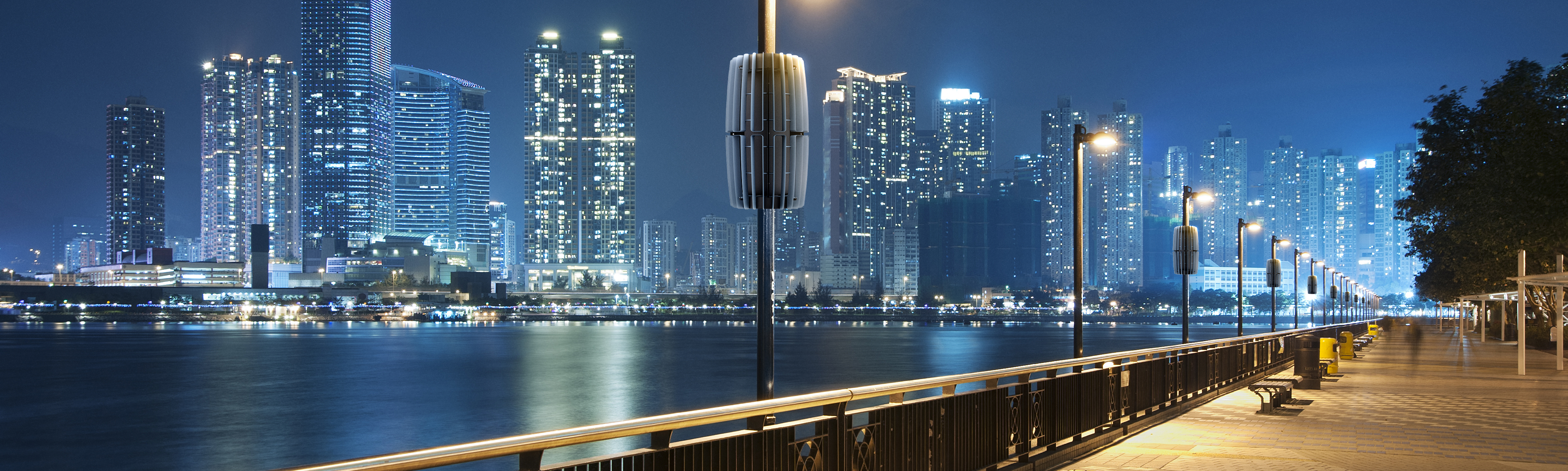
The PAMARES (Particulate Matter Reduction System) is an outdoor electrostatic air purification system developed for urban roadside air quality improvement. Using electrostatic precipitation technology, it captures fine particulate matter — including PM10, PM2.5 and ultrafine particles — directly from ambient air without the need for traditional filters. The system can be integrated into existing infrastructure such as lighting poles, allowing cities to reduce traffic-related particulate pollution at locations where exposure is highest.
A well-known deployment is located at Omonia Square in Athens, where PAMARES units were installed to help reduce particulate pollution in a dense urban traffic environment. Similar initiatives have also been explored in major metropolitan areas such as Seoul and Busan, where traffic emissions remain a major urban challenge.
We will also present the FDRS (Fine Dust Reduction System), developed for road tunnels and enclosed traffic infrastructure. Tunnel environments often concentrate particulate pollution because traffic moves continuously and air dispersion is limited. Tunnel portals are therefore increasingly recognised as emission hotspots where concentrated pollution can enter nearby urban areas.
By capturing particulate matter inside the tunnel, the FDRS system helps reduce tunnel traffic emissions and particulate pollution before tunnel air is released into the surrounding city environment.
One example can be found in the Victory Boogie Woogie Tunnel in The Hague, part of the Rotterdamsebaan. The tunnel integrates dozens of StaticAir purification units designed to reduce particulate matter emissions from tunnel traffic.
Beyond road transport, interest in ultrafine particle pollution is also growing in other sectors. Airports, for example, are increasingly studying ultrafine particle emissions around runways and ground operations, reflecting a broader shift toward managing air quality impacts across mobility infrastructure.
Intertraffic Amsterdam provides an important opportunity to exchange insights with cities, infrastructure operators, and industry partners working to reduce traffic emissions and improve urban air quality.
If you are attending Intertraffic Amsterdam, we invite you to visit StaticAir at Stand 02.105 to discuss real-world case studies, regulatory developments, and practical solutions for reducing particulate matter in traffic environments — from busy urban roads to tunnel infrastructure.
read more..
Search for StaticAir to Meet Industry Partners at Intertraffic Amsterdam 2026 in the web..
Latest links