SHARE THIS:
Search for The Future of Electronic Warfare and AI Powered Defense Technologies in the web..




![[[##.FAQ Support]] Quickbooks Pro Plus Support](https://i.vimeocdn.com/video/2170832630-b88f025fdaaf3a9cfdfd453fad0bc540e06d76707ccb0f5a1e90263d42b18add-d?f=webp®ion=us "[[##.FAQ Support]] Quickbooks Pro Plus Support")


![How to Talk To Quickbooks Customer Support (CA USA) [2026]](https://i.vimeocdn.com/video/2170834073-721997d39809b0951501b55d62d34d79860165718cab3a5d4071f3320e0b9a62-d?f=webp®ion=us "How to Talk To Quickbooks Customer Support (CA USA) [2026]")

Found: 19.06.2026
The Future of Electronic Warfare and AI Powered Defense Technologies
Military superiority has traditionally been measured by troop strength, firepower, and technological sophistication. Today, another battlefield is becoming equally important: the electromagnetic spectrum.
Modern military operations rely on uninterrupted communication, radar detection, navigation signals, targeting systems, satellite links, and intelligence networks. These systems create an invisible operational environment where information moves continuously between platforms, commanders, sensors, and warfighters.
The ability to control this environment increasingly determines operational success.
As adversaries adopt more advanced radar systems, autonomous platforms, electronic attack capabilities, and networked communications, military organizations are investing heavily in electronic warfare technologies designed to detect, disrupt, deceive, protect, and dominate the electromagnetic spectrum.
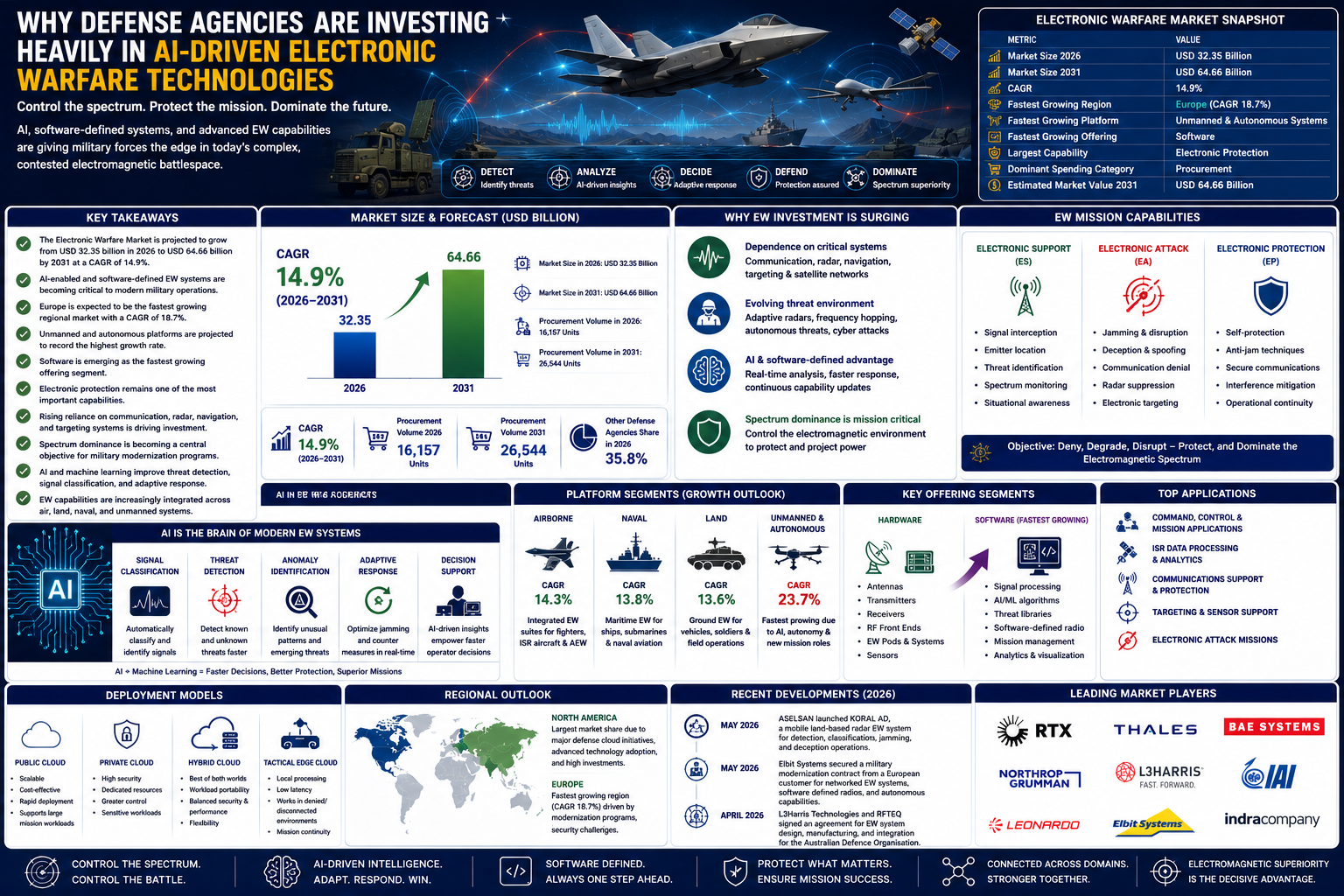
This shift is reflected in the rapid expansion of the Electronic Warfare Market, which is projected to grow from USD 32.35 billion in 2026 to USD 64.66 billion by 2031, representing a CAGR of 14.9%.
Unlike previous generations of EW systems that relied heavily on hardware intensive architectures, the next generation of electronic warfare is increasingly driven by artificial intelligence, software defined capabilities, advanced digital receivers, and integrated cyber electromagnetic operations.
These technologies are enabling military forces to respond more effectively to evolving threats while improving operational flexibility across air, land, naval, space, and unmanned platforms.
Read the Full Report:
https://www.marketsandmarkets.com/Market-Reports/electronic-warfare-market-1301.html
Download Sample Report:
https://www.marketsandmarkets.com/requestsampleNew.asp?id=1301
read more..
Search for The Future of Electronic Warfare and AI Powered Defense Technologies in the web..
Latest links
Website Info
Category: Aerospace & DefenceFound: 19.06.2026
Rate!!
Please write a comment: